· 6 min read
Riddle Quest has grown beyond its original solo puzzle loop. The latest work brings live head-to-head races, friend challenges, more achievement milestones, and a coin economy that makes help more affordable.
The core idea remains the same: start with a riddle, make a word guess, and use colour-coded feedback to narrow the answer. Classic Mode and the Daily Challenge still anchor the experience. Around them, the current HTML5 game now has a much stronger social and progression layer.
This update covers the repository's latest work as of 2 October 2026. It includes features checked in hosted test builds alongside newer changes verified locally, so it is a development update rather than a public launch announcement.
Live competition with Race to 10
Multiplayer now opens a live PvP category selector. Choose a category, start matchmaking, and meet an opponent in a lobby that shows both players before a shared five-second countdown. If a human opponent is not found within a minute, a bot supplies the match.
Both players receive the same server-selected questions, with progress shown during play. The latest scoring update tracks riddles completed: correct answers and skips both advance the run, while help adds time penalties. Hints add 15 seconds and skips add 45 seconds to adjusted time.
Those penalties now matter at the finish. If a player completes their run with penalties, the rival can continue within the remaining adjusted-time allowance. The lower completed adjusted time wins; equal completed adjusted times draw. A winning player receives 50 coins, with the result and reward settled by the server.
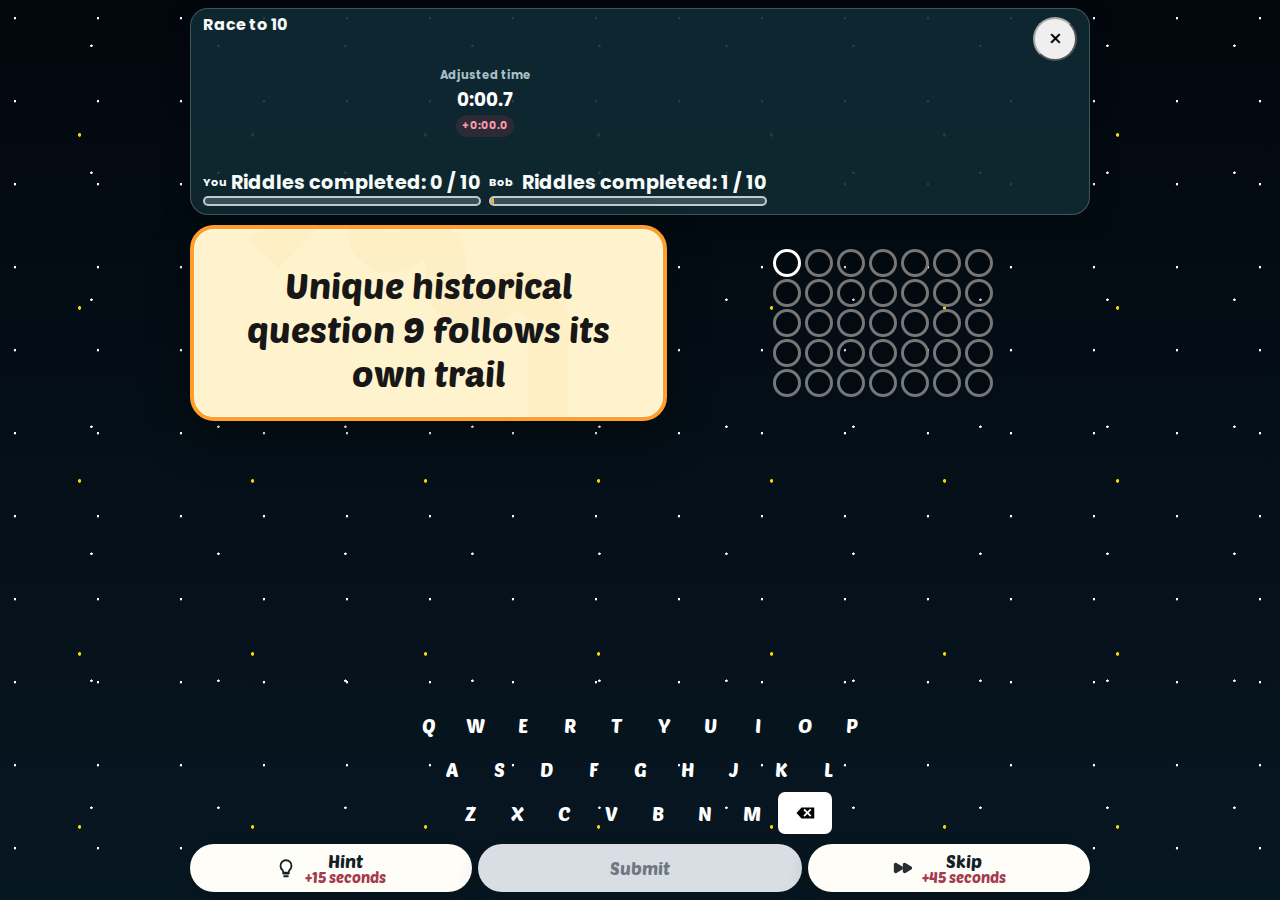
The multiplayer entry has also been simplified around live play. Recorded-race navigation has been removed from the current interface. Platforms without live matchmaking show its availability clearly.
Recovery has received particular attention: reloading a lobby, losing a connection, retrying a submitted guess, or opening another tab should preserve authoritative progress and avoid duplicate rewards. The latest skip-progress and adjusted-finish changes have passed local browser and backend checks; their evidence notes do not record a production deployment.
Challenge a friend
On supported Jest and Facebook hosts, Challenge a friend reserves a private lobby and opens the platform's native invitation or sharing flow. The recipient sees an invitation and chooses whether to join. Receiving an alert never automatically accepts a match.
Friend challenges have been checked in an active Jest test build and a Facebook build in Testing. Hosted checks confirmed lobby creation and the native Facebook friend picker. They did not send an invitation to another person or establish real SMS delivery.
Challenge alerts now have controls in Settings and Profile. The Jest notification worker has also been tested with every game page closed, producing a browser notification from an injected push event. Actual delivery through Firebase Cloud Messaging to a player's device remains a separate verification step.
Coins go further
The solo economy has been rebalanced around lower help costs and rewards that reflect the authored difficulty of a riddle.
- Reveal a hint letter: 25 coins.
- Buy an extra attempt: 50 coins.
- Skip a Classic riddle: 100 coins.
- Classic win rewards: 25 coins for easy, 40 for medium, and 60 for hard riddles.
- Daily win rewards: 75 coins for easy, 100 for medium, and 125 for hard riddles, before applicable streak bonuses.
The three help prices have been halved. An easy Classic win now earns enough to cover one hint, while harder riddles pay more without increasing the price of help. Existing streak, level-up, and eligible achievement bonuses retain their rules.
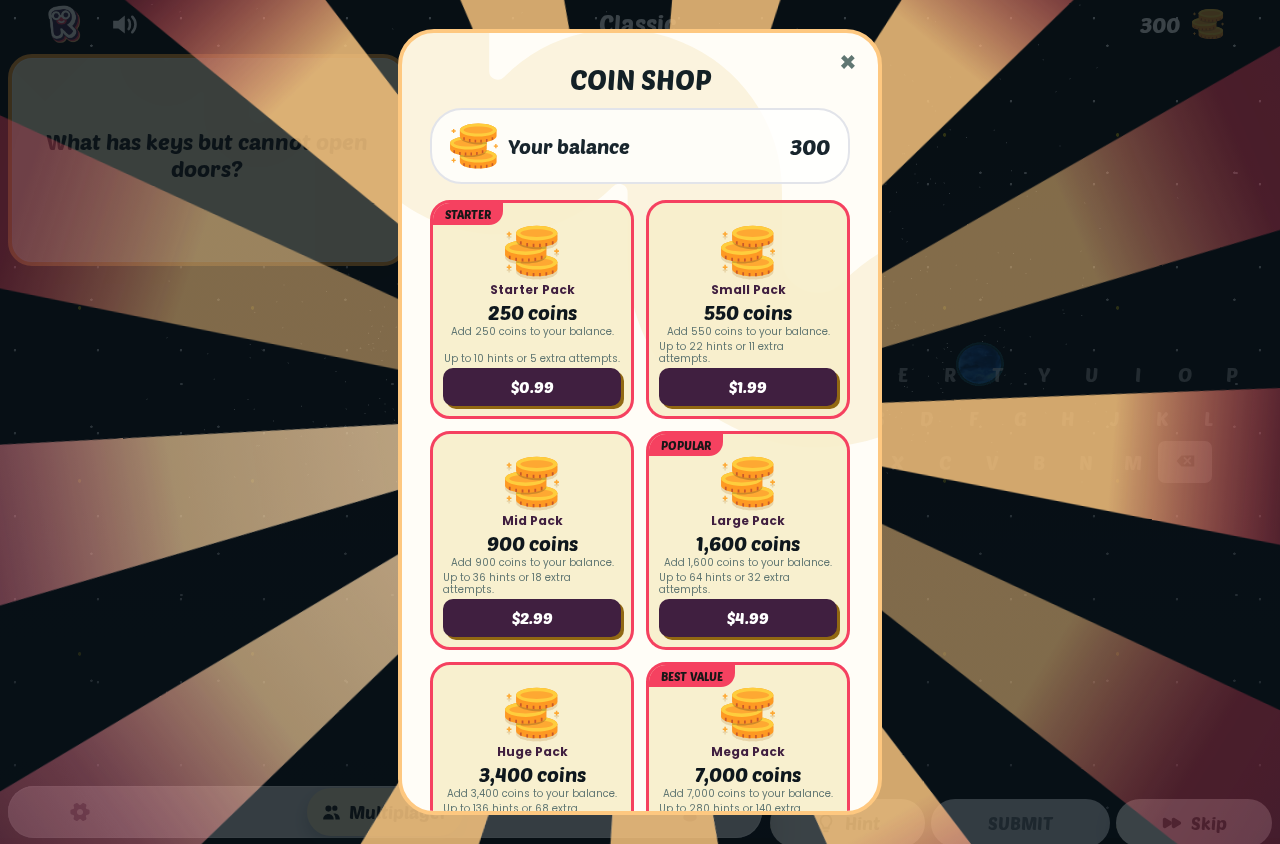
The shop makes purchasing power easier to understand by showing the number of hints or extra attempts a pack can fund. Jest's six existing coin packs were also repriced so larger bundles offer progressively better value per dollar. The deployed economy rules and corrected Jest catalogue were checked against the hosted build; no real-money checkout was performed during that verification.
Twelve new achievement milestones
There are more goals for both new players and regular solvers. The latest expansion adds 12 solo achievements, including milestones for 10 and 250 wins, 10 and 250 riddles played, Classic progression at levels 5 and 150, Daily completions and wins, a 60-day best Daily win streak, and 10,000 XP.
That brings the catalogue to 61 achievements on server-backed targets and 53 on the self-contained solo targets. The added milestone names and descriptions are translated across all 16 supported languages.
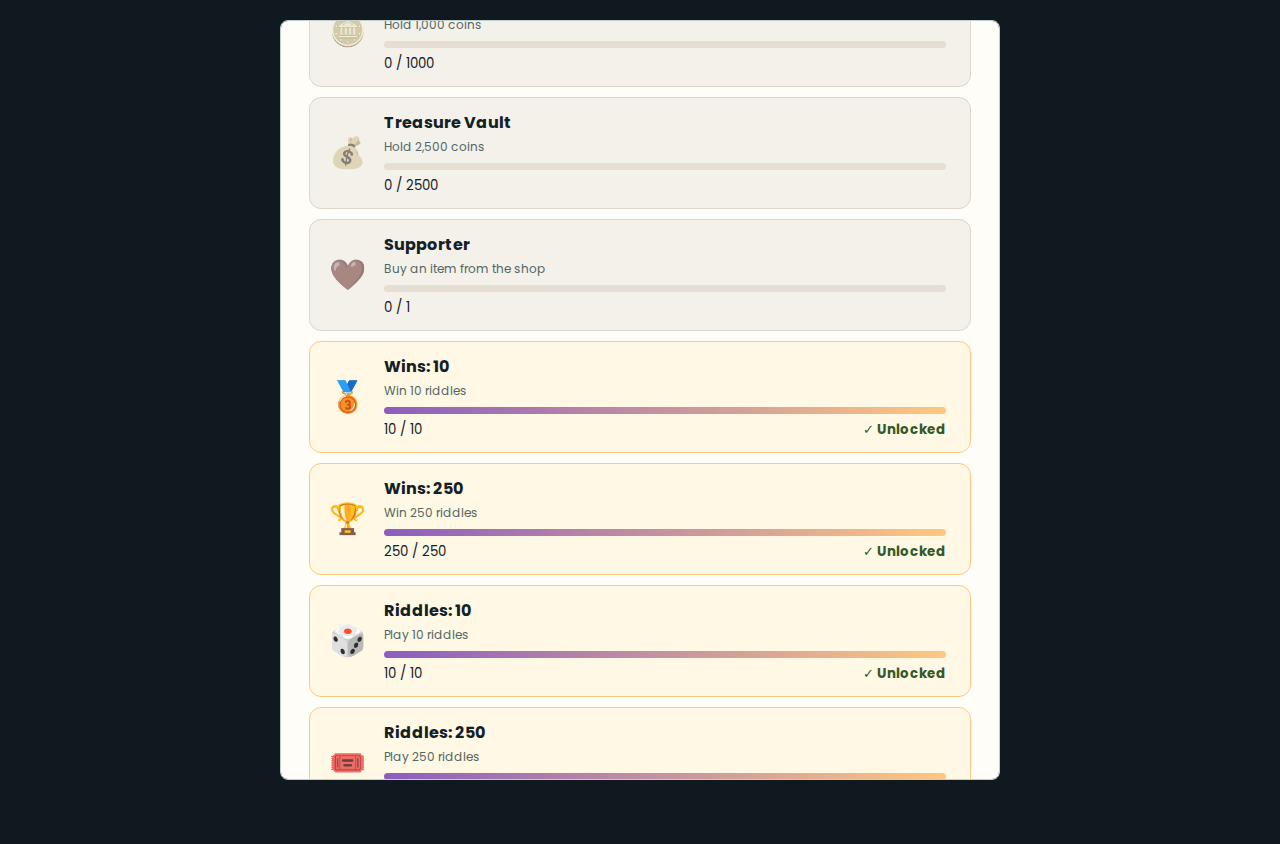
Unlocks use the existing reward rules, and replay checks verify that an already-settled achievement does not pay twice. On the self-contained YouTube, Netflix, and Yahoo artifacts, gameplay checks also confirmed that earned badges survive saving and reloading.
Fairer rewards and stronger content handling
The latest backend work extends eligible first-win referral handling to live multiplayer on Facebook and Reddit. Referral settlement uses the committed server result, with retry protection and provider-specific eligibility limits. The newest Reddit integration is locally verified; live signed-post acceptance remains outstanding.
Answer and hint payloads have also received a protection pass. Selected bundled content and supported solo responses now use encrypted envelopes to deter casual inspection of files and network responses. Hosted Jest checks confirmed encrypted hint and Classic buffer delivery, normal puzzle progression, and restored hint state after reload.
This is an inspection deterrent: the browser can still decode content needed for play. Competitive fairness comes from server-owned validation, scoring, and rewards. Live PvP keeps answers on the server.
Where the builds stand
The main target set remains Jest, Facebook, Reddit, YouTube, Netflix, and Yahoo. Features follow each target's supported capabilities. YouTube is self-contained and uses its Playable save lifecycle; the Netflix and Yahoo artifacts remain self-contained engineering candidates with local saves.
The latest evidence records successful isolated builds and artifact checks across those six targets, plus desktop and mobile browser verification for the new flows. That build coverage does not mean every platform has approved or publicly released the game.
Jest has an active test build, Facebook has a build in Testing, and the game remains unpublished on those platforms according to the deployment notes. Real invitation delivery, offline device notifications, hosted multiplayer acceptance, and broader release checks still need attention. Some broad checks also retain coverage, documentation, and retired recorded-race test failures; the focused feature checks should not be mistaken for a completely green release gate.
The next milestone is to turn these verified development changes into a coherent release candidate and put the updated experience in front of players. The most useful feedback will be whether live races feel fair, friend challenges are easy to join, and the new rewards support a satisfying rhythm of solving and progression.